


Every political era eventually forces a reckoning—not with our enemies, but with the tools we use to resist them.
For nearly a decade, the dominant emotional currency of American progressivism has been righteous indignation. We have watched the slow-motion dismantling of democratic norms, the rise of ascendant authoritarianism, and the shift of a major political party into a permanent, reactionary movement. In response, millions of people have done what they were taught to do: they posted, they marched, they vented, and they donated five dollars at a time to frantic inbox appeals.
Yet, after ten years of emergency fundraising emails, viral protest signs, and Cable news rants, we find ourselves at the exact same crossroads, only with higher stakes and fewer options.
It raises an uncomfortable but necessary question: At what point does anger cease to be a tool for liberation and instead become a mechanism for keeping us compliant?
To move forward, we must dismantle two deeply ingrained myths: first, that pure rage is a viable long-term strategy; and second, that the institutions meant to protect us are simply waiting for us to ask nicely.
The Trap of Political “Sane-Washing” and Moral Shame
A central failure of modern political commentary is the persistent attempt to “sane-wash” authoritarian rhetoric—to treat fundamental assaults on human dignity as standard policy debates to be analyzed over Sunday morning talk shows.
This media ecosystem serves a specific function: to make the affluent political class feel better about an unsustainable status quo. It reassures neoliberals and institutional donors that as long as they hold the right values, sign the right petitions, and fund the right foundations, the guardrails will hold.
For decades, political movements have relied heavily on moral shame—the belief that if you simply expose the hypocrisy or cruelty of your opponent, they will be forced by public pressure to act correctly.
You cannot shame the devil.
Authoritarian movements do not care about bad press, declining approval ratings, or snarky protest signs. They do not care about how history will record their actions, because history is written by those who secure power. Treating politics like a popularity contest while the opposing side treats it like a war over structural power guarantees defeat.
The Difference Between Catharsis and Organizing
The fundamental divide in modern politics is not just between the Left and the Right; it is between catharsis and infrastructure.
Consider the history of transformative social change in the United States. The victories of the New Deal, the Civil Rights Movement, and the early Labor Movement were not achieved because a political establishment decided to do the right thing out of the goodness of its heart. They occurred because grassroots organizers built formidable, discipline-heavy coalitions that forced the political class to comply.
Lessons from Historic Movements
Training over Tension: In the 1960s and 1970s, mass demonstrations were rarely stand-alone events. They were backed by community teach-ins, civil disobedience workshops, and mutual aid networks that prepared participants for long-term resistance.
Local Infrastructure: Opposing movements spent 40 years quietly building power from the ground up—targeting school boards, state legislatures, and judicial appointments.
Sustainable Engagement: Protests were designed not just to vent frustration, but to capture, train, and deploy human capacity into local organizing.
Modern politics often substitutes this hard work with aesthetic performance—expensive rallies featuring celebrity appearances, produced not to build power, but to deliver an emotional high. Catharsis makes us feel comfortable with our discomfort. It allows us to process our anxiety without demanding the discomfort of real, structural conflict.
From Uncontrolled Rage to Strategic Projection
Rage is an understandable human response to systemic collapse. It activates us. It gets us off the couch. But psychologically, constant activation triggers basic survival responses: fight, flight, freeze, or fawn.
Living in a state of perpetual outrage drains the very cognitive and emotional reserves required to think strategically. When you only own a hammer, every problem looks like a nail; when your only emotional register is fury, your response to every crisis is to burn out.
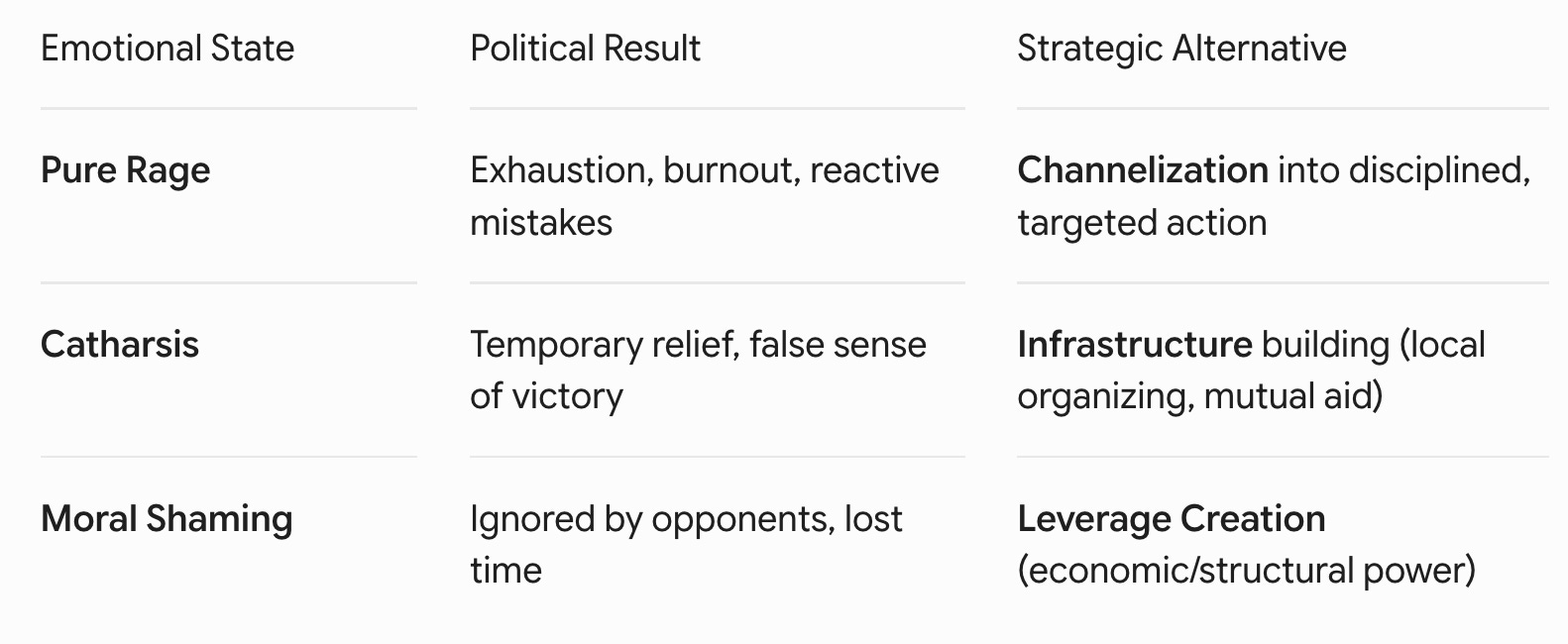
Reclaiming our agency requires moving beyond raw emotion toward long-term projection—asking where we want to be in five, ten, or twenty years, and what institutions we need to build today to get there.
Choosing Real Action Over Nostalgia
The political party systems as currently constructed no longer serve the vast majority of working people who desire material safety, healthcare, and economic stability. Waiting for an autopsied establishment to suddenly pivot is a strategy rooted in denial.
If we want to pull society back from the brink, we must abandon the delusion that simply “voting every November and posting about it” is sufficient.
Stop buying into performance: Disengage from media ecosystems designed purely to monetize your terror or give you cheap emotional relief.
Focus on local leverage: Shift focus to city councils, school boards, regional unions, and community defense structures where direct action yields measurable results.
Build durable networks: Prioritize face-to-face organizing and skills-based training over online consensus and digital outrage.
The feeling that something fundamental is breaking in our political system is real. Putting that discomfort on layaway only ensures it returns later with compounding interest. The task ahead is not to scream louder at a broken machine, but to build something capable of replacing it.


